

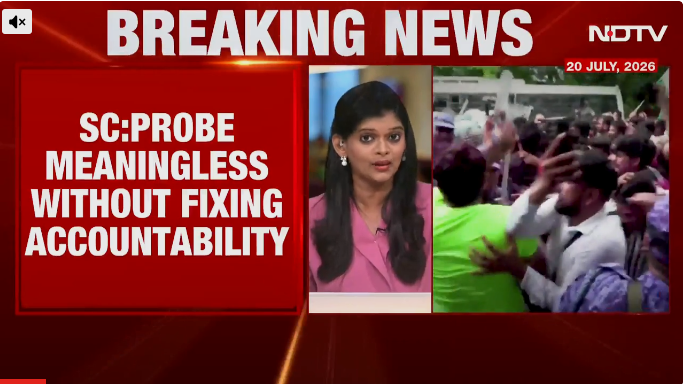

Demonstrations in the national capital turned violent on July 20 when a crowd, spearheaded by the CJP, attempted to march towards Parliament from the Jantar Mantar protest site. Police fired tear gas and used batons to disperse the protest, triggering clashes and a wave of detentions.
The police needs a new protocol during agitations, the Supreme Court underlined on Tuesday, pointing out that the cops did not follow earlier laid down rules during the Cockroach Janta Party-led student protests.
Dealing with a batch of pleas alleging police excesses against students protesting irregularities in exams and the NEET paper leak across the country, a bench headed by Chief Justice of India Surya Kant referred to many incidents of violence.
“There has to be completely independent probe. Whosoever committed excesses, took law in their hands should be taken to task. Probe is meaningless if no responsibility is fixed,” the Chief Justice said.
Read | “Can’t Lathicharge Just Because There Is Agitation”: Supreme Court’s Big Remark
Demonstrations in the national capital turned violent on July 20 when a crowd, spearheaded by the CJP, attempted to march towards Parliament from the Jantar Mantar protest site. Police fired tear gas and used batons to disperse the protest, triggering clashes and a wave of detentions.
“We do not think there is a need for elaborate arguments. This was a completely peaceful protest by students, in which certain demands were raised. It took place within the constitutional framework. They had their own perspective; they want to point out that in such peaceful protests, there are always uninvited guests. They arrive with an agenda, and very soon, they become co-hosts,” the Chief Justice said.
The top court again underlined that protests are part of democracy and it needs to be debated if measures like the use of tear gas be permitted.